Worldwide and US mobile subscriber penetration (Dec 2008)
Worldwide Mobile Subscriber Penetration
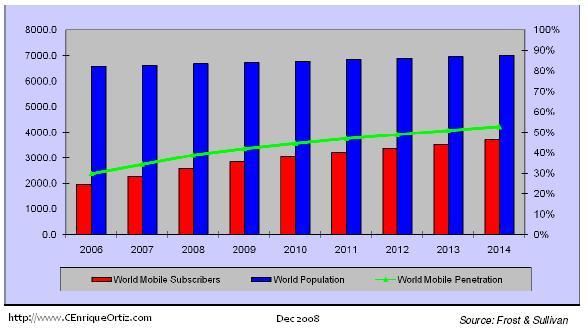
With 42% penetration in 2008 and 53% penetration by 2014 worldwide.
US Mobile Subscriber Penetration
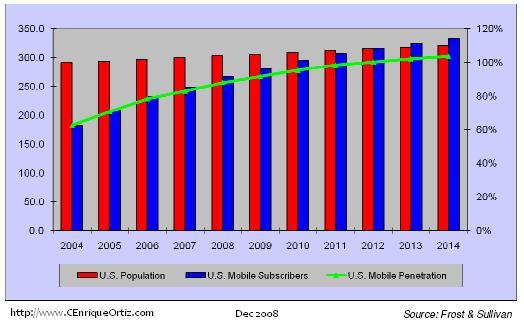
With 88% penetration in 2008 and 104% penetration by 2014 in the United States. The above numbers for the US matches the penetration numbers reported by CTIA for 2008 of 88%; as I blogged the other day, “as of today, CTIA reports there are 269,605,965 subscribers in the US, while the US census shows there are 305,477,551 people in the US (Dec 24 2008)”. By 2014 US subscriber based is projected to be past 100%.
Yes the above numbers for the US are lower and slower than other parts of the world, but taking into consideration the size of the US population, it really is a great penetration (i.e., it is much harder and takes longer to penetrate a very large population).
There is a correlation between population size and subscriber penetration. To show this below you can see the correlation between “advanced country” as defined by Tomi Ahonen’s in his book Mobile as the 7th Mass Media (a great book that I recommend) vs. size of population, with Japan being the exception; the list below follows the order of “Advanced Mobile Countries” table in page 285 of the book:
- Japan Population: 127,433,494 (July 2007 est.)
- Korea, South Population: 49,044,790 (July 2007 est.)
- Italy Population: 58,147,733 (July 2007 est.)
- Austria Population: 8,199,783 (July 2007 est.)
- United Kingdom Population: 60,776,238 (July 2007 est.)
- Finland Population: 5,238,460 (July 2007 est.)
- Israel Population: 7,112,359 (July 2008 est.)
- :
- Singapore Population: 4,553,009 (July 2007 est.)
- :
- Hong Kong Population: 6,980,412 (July 2007 est.)
- :
- France Population: 64,057,792 (July 2008 est.)
- :
The following countries are not in the list of advanced countries, but have the largest population:
- China Population: 1,321,851,888 (July 2007 est.)
- India Population: 1,129,866,154 (July 2007 est.)
- United States Population: 301,139,947 (July 2007 est.) — in Texas alone as of 2006 there were 23,507,783
ceo
Source: Frost & Sullivan | Visions 2009 Paradigm Shifts in Mobile & Wireless Communications | J. Gerry Purdy, Ph.D., CIA World Factbook, Fact Monster, US Census Bureau


Hi CEO
Great stuff as per usual, and thanks for kind words about my book.
About that F&S forecast for the US subscription penetration rate and the US cellphone population.
I totally agree with the general forecast direction, that the subscription count will pass the total population count.
My gut says it will happen faster than this. F&S says 100% subscription penetration in 2012. I’m pretty sure it’ll happen faster, and my guess would be 2010.
With handsets F&S seems to think the number of handsets will plateau and not reach the total population.
I disagree with that, I am sure also the total number of handsets will grow past the total US population, as increasingly many employed young adults will carry two phones, think iPhone user who also has a Blackberry.
So, let me first give some background to the F&S forecast, while not knowing specifically the forecasters of F&S (I do work with them, but their London office, and don’t know the analysts nor the process by which this forecast was made). The general assumption in the telecoms industry has had a strong, long-held assumption, that subscriber growth is very near saturation. We heard that when penetration rates passed 50% of human population (at a time when landline penetration was 60%). We heard it again at 60%, then at 70% then at 80%, 90%, 100% and 110% and 120%. As you know CEO, but perhaps your readers might not, the European penetration level is already at 110% and leading countries are past 135% (like Italy, Taiwan, Hong Kong, Israel etc).
So it makes “sense” for F&S to be cautious in their forecast, trying to conform with a general more-or-less consensus view, that cellphone subscriber penetration rates cannot keep on growing, they have to be near saturation by now. And the area where that feeling is strongest held still today, is America, so American analysts do tend to think that 100% is a natural barrier for penetratoin (babies don’t need phones).
We’ve of course witnessed the breaking of that myth in more than 60 countries already, but it still guides a lot of the assumptions about penetration rates.
The reason I think the subscriber growth will be faster than this, is that by my analysis, the two major accelerators to subscriber growth are a) the availabilty of prepaid (pay-as-you-go) accounts; and b) subsidies to handsets. So that is why Italy shot ahead of Finland in the late 1990s in the national penetration race, because Italy (and Portugal) introduced prepaid accounts, which spread the cellphone to a far less affluent part of society, where the recepient can still receive calls and messages, even if they can’t afford to place them (oh, and an important point here, almost all of the rest of the world has already abandoned the archaic payment method, where a cellphone owner is charged both for placing calls and receiving calls (and messages). In the rest of the world we only pay if we call or send messages, receiving them is free. But sorry, I am digressing.
Yes, the other matter that accelerates growth is the subsidised handset. Low cost, and even free phones. Your readers might think that this is the “natural state” of cellphones, but no, many countries don’t have subsidies at all, either being illegal, or the industry has managed to get rid of them. Finland, Belgium, South Korea and Israel are examples of such countries. The fact that the UK had subsidised phones, and Finland didn’t, helped the UK pass Finland in national penetration rates.
Now, with these two factors helping boost the US market, I think the US growth rate, from the 90% level where it is now, to the 100% level, will actually be stronger than for an average industrialized country that went through the same stage (US is second-to-last in penetration rates today among Industrialized Countries, ahead only of Canada – so we have a lot of examples from other countries that we can study).
I generally have pegged the US industry to be about 3 years behind the UK in the cellular phone industry (the world leader is Japan). But the US has been moving faster up that ladder – as CEO knows as I have the table in the book of the 25 leading countries in mobile telecoms. Today the US lags the UK only 2 years and lags Japan only a little more than 3 years. It is partly an “iPhone effect” of the US industry finally waking up to the cellphone opportunity (although, I can’t believe this lunacy about AT&T now RAISING prices for SMS, what kind of idiots are they? But I digress)
Anyway, I wanted to offer my alternate view. We’ll know soon enough. But your readers should consider that F&S forecast – and that I agree with it – but then consider also, that Tomi Ahonen – who after all was the first expert to discuss the multiple subscription phenomenon when we first spotted it in Finland in 1998 – says it is likely to be faster growth than this. If the evidence suggests the growth pattern is similar to F&S, then Tomi was wrong, and you can plan on that forecast. If you notice the numbers next year trend above the F&S forecast, then it is likely Tomi was closer to the mark, ha-ha, and you’ll be better served in preparing for that future.
Just some alterate views here at the end of the year 2008. Happy new year to all readers of the About Mobility blog.
Tomi T Ahonen
http://www.tomiahonen.com
Thanks for sharing. Sadly, Canada is even further behind the U.S. in terms of adoption – and we are only have about 32 million people with 21 million subscribers.
[...] Con respecto a los ingresos, los ingresos por servicios crecieron un 7.5% en 2008 y las proyecciones apuntan a un crecimiento en los ingresos del 3.9% en 2009. Algo menos, pero todavía los números se escriben de color negro, por lo que no hay que temer mucho. Vía mobileburn y Enrique Ortíz [...]
[...] to [ weblog.cenriqueortiz.com ] With 88% penetration in 2008 and 104% penetration by 2014 in the United States. The above numbers [...]
[...] Nearly 90 percent of Americans have a mobile phone. [...]