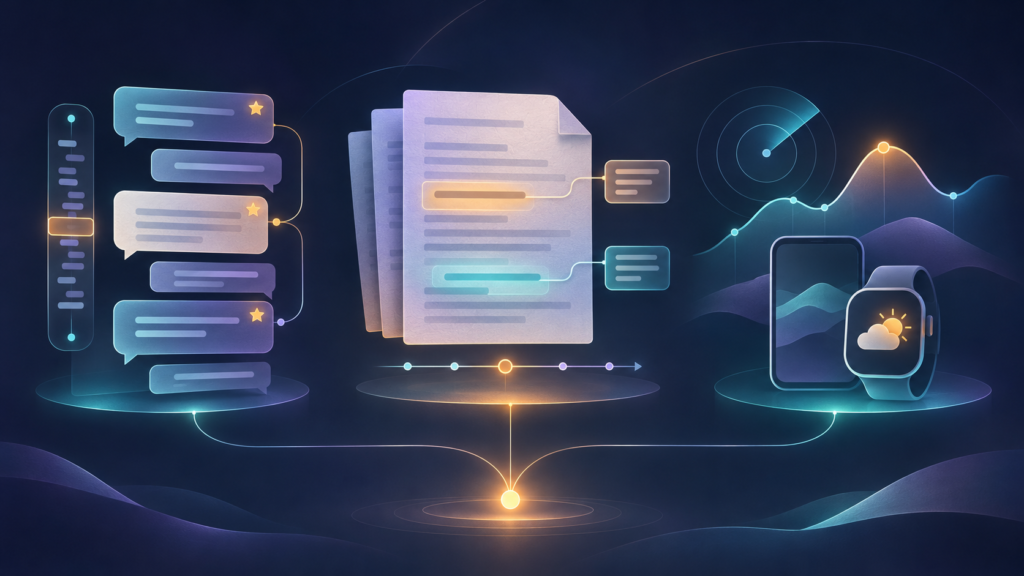
I’ve been giving some of my projects a home at HyperKode: a quiet corner of the internet for writing, building, and experimenting with systems, software, and technology ideas.
The projects cover different ground: navigating AI conversations, making sense of caregiver reports, and exploring weather observations. Each starts with something practical that I want to understand or make easier. Building the software becomes a way to explore the problem, test engineering choices, and learn from using the result.
Three projects are initially taking shape there.
Chat Minimap
Chat Minimap grew from a familiar experience: a useful exchange gets buried in a long AI conversation. You remember discussing something, but finding it again means scrolling, searching, and trying to reconstruct where the conversation went.
Minimap adds a navigable overview alongside ChatGPT and Claude. You can move between exchanges, search and filter turns, add stars and notes, and export the parts you want to keep. It is now available in the Chrome Web Store.
The engineering exploration goes beyond the map itself. Viewers offer different ways to read the same conversation, including Cloudmap, Outline, and Graph. Overlays add another layer of context. An internal component framework gives me room to try new viewers and overlays while reusing the underlying conversation model and lifecycle.
Core navigation works without AI. Optional AI features provide another set of tools, with their own configuration and data-processing boundaries. The experimental local conversation library takes a separate path: imported snapshots that can be searched and read without a live connection to the original conversation.
Carelytics
Carelytics comes from the experience of following someone’s care through reports scattered across emails and PDFs. Individual reports contain useful information. Understanding the story across days, shifts, and revised documents takes more work.
I built it to help answer practical questions: what happened, what changed, what needs follow-up, and which source supports an observation.
Carelytics started as a traditional web application, with a web server, a Postgres database, document storage, and scheduled jobs. AI was one component within that application. As I worked with it, the project evolved into a hybrid AI system, with specialized agents taking a larger role in reviewing reports and coordinating workflows, while code continued to enforce storage, validation, and tool contracts.
Today, Carelytics combines those agents with a private local service and SQLite evidence history. ChatGPT connects to focused local tools through MCP. Separate authorized Scheduled workflows provide email notifications and daily summaries, which I also use.
That evolution makes the boundary between code and agent judgment especially important. Code enforces storage, validation, and query contracts. Agents review document identity, dates, conflicting versions, and narrative context. Source citations help trace observations back to the reports, but structural checks cannot establish that an interpretation is clinically correct. Carelytics remains an evolving private prototype requiring human review.
PWS Watch
PWS Watch starts with another kind of observation: the weather measured by a personal weather station.
A current temperature is useful. Its history adds context. Forecasts and radar add different perspectives. PWS Watch brings those pieces together across a web dashboard, iOS, and Apple Watch.
The design challenge is partly about deciding how much information belongs on each screen. A desktop has room for maps and historical detail. A Watch needs a useful glance. The wording should remain consistent even when the presentation changes.
It also matters where a statement comes from. An observation describes a measurement. A forecast describes an outlook. Falling pressure alone does not establish that rain is coming. AI can help explain supplied evidence, but those distinctions still belong in the underlying system.
Across these projects, I keep returning to similar questions: where should state live, what should code enforce, where does AI help, and how can the interface make uncertainty understandable?
HyperKode gives me a place to explore those questions through working software. Some ideas will remain experiments. Others may grow through use and feedback. I want to share both the tools and enough of the engineering behind them to make the choices understandable.
You can explore the projects at hyperkode.com.
Disclaimer: HyperKode and the projects described here are personal work, developed on my own time and equipment. The views expressed are my own.