The DRY (Don’t Repeat Yourself) principle is fundamentally a software development principle focused on avoiding duplicated code, logic, and knowledge. While that remains its primary intent, the same mindset applies beyond software development and into operational activities. I like to refer to this broader interpretation as the DRY+ principle.
Repeated manual operational activities, recurring administrative work, and repetitive reporting often indicate an opportunity for standardization or automation. DRY+ extends this mindset across software and operations, encouraging us to eliminate unnecessary repetition wherever practical.
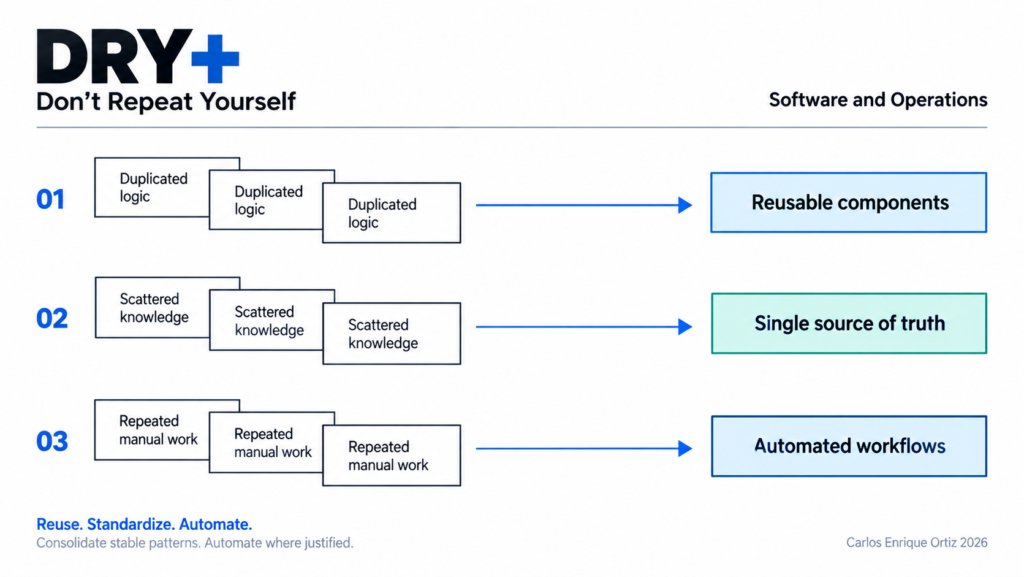
Software and Operations
In software, DRY encourages us to define knowledge, business rules, transformations, and logic once, then reuse them wherever needed. In operations, we look for repeated manual steps that could be standardized or automated.
For example, if three applications implement the same validation rule, a shared component gives us one implementation to maintain and update. If someone also prepares a weekly report by manually collecting results from those applications, an automated workflow can reduce the effort required to produce it. One addresses duplicated logic; the other addresses repeated execution.
As our systems, automations, and AI solutions grow, duplicated implementations create more places to maintain, troubleshoot, and update. Repetitive manual processes also consume time and introduce opportunities for errors.
Applying DRY+
DRY does not mean abstracting, separating, or componentizing every piece of code. It means avoiding unnecessary duplication. If the same logic, prompt pattern, API integration, validation rule, workflow, or process exists in several locations, we should consider whether it belongs in a shared component, library, service, reusable framework, or standard operating procedure.
Similar-looking implementations may serve different requirements. Before consolidating them, make sure the underlying logic is actually shared and stable enough to reuse.
When applying DRY+:
- Reuse existing components before creating new ones.
- Extract repeated business logic into shared functions, services, or libraries when the underlying rule is the same.
- Standardize common patterns for integrations, prompts, error handling, testing, and telemetry.
- Maintain a single source of truth for configuration, documentation, and business rules, with clear ownership.
- Automate repeatable operational activities whenever the cost and complexity are justified.
- Prefer simple duplication over premature abstraction when a pattern has not yet stabilized.
A practical guideline is the Rule of Three: the first occurrence is implementation, the second may be coincidence, and the third repeated occurrence is usually a signal to consider consolidation or automation. It should prompt us to examine the pattern, rather than automatically create a shared implementation.
For operational activities, consider the frequency, effort, and cost of errors against the work required to build and maintain the automation. Some tasks are fine to keep manual. Others can be partially automated, such as collecting and preparing information for someone to review.
The goal is easier maintenance, greater consistency, repeatability, and faster delivery. Every duplicate implementation creates another place where defects can occur and updates can be missed. Repetitive manual work can limit the team’s capacity as demand grows. Apply DRY+ by consolidating shared logic and knowledge, standardizing common processes, and automating repetitive activities wherever practical. The result is increased impact for both individuals and the team as a whole.