Mobile Internet Programming: Browser, Web Runtime, Local-based Applications
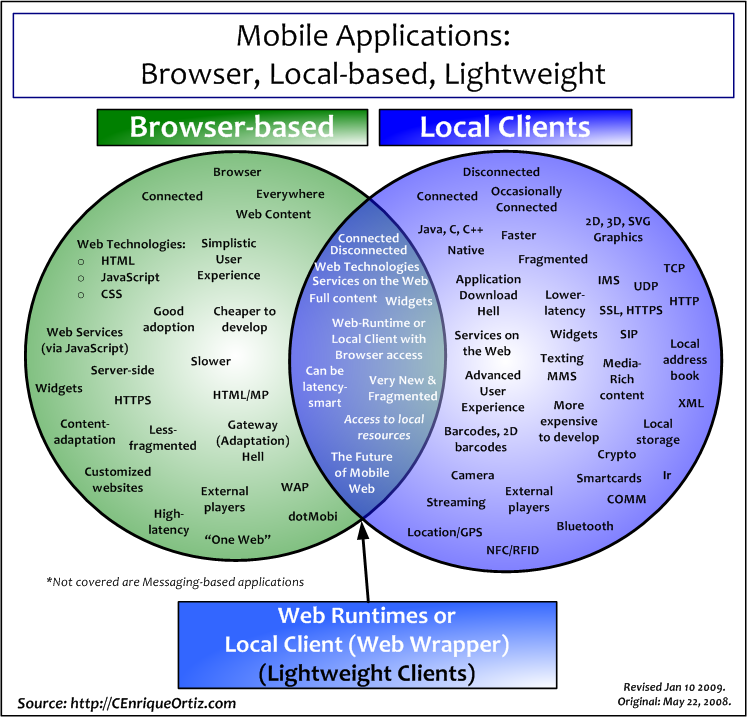
Below is a diagram that will appear on a piece that I am writing titled Mobile Internet Programming. The diagram presents (and compares) the attributes for the different methods for mobile software programming:

Click to Enlarge — Mobile Internet Programming: Browser, Web Runtime, Local-based Applications.
This is work in progress…
Comments are welcome.
ceo
Update 1 - May 23 ‘08: I just found these two excellent presentations by peer Mobilists Barbara and Paul, slides that complement the diagram above:
- Going Mobile (Barbara Ballard)
- Decided To Mobilise? How to Engage with the Mobile Internet User (Paul Golding)
Update 2 - May 24 ‘08: I’m not too satisfied with the above visualization approach to show the characteristics of the different mobile applications… plus and it is missing the fourth method, mobile messaging-based apps.


My 2 cents…
I think in the context of delivering content/application for mobile, you have to consider the relevancy and context…. Mobile usage patterns confirm the - “anywhere, anytime, anyhow” - integrated service proposition based on a timely and efficient delivery of the right content presented the right way at the right place and time, adapted as necessary to the network, environmental conditions, device capabilities and user preferences. In particular, using the best available input and output modalities to facilitate user interaction with an application and access to the relevant Web content in every context is critical e.g., by combining voice and visual inputs and outputs.
And on the topic of mobile browsers…. they continue to lag behind their desktop equivalents in terms of rendering capabilities and performance. Furthermore, a promising idea of evolving a browser into THE mobile user interface of the future appears to be completely stalled due to a continued fragmentation of the browser market and persistent interoperability problems. No one mobile browser vendor yet managed to achieve a dominant market position and the ongoing standardization initiatives including those under the auspices of the Open Mobile Alliance (OMA) appear to be progressing slower than expected. In a nutshell, fragmentation is not just a J2ME problem, but it is also happening to the embedded browser space.
Hi Mika.
Totally agree on “relevancy and context” - that is what we are building at eZee inc.
On mobile browsers lagging behind w.r.t. functionality when compared to web browsers, yes that is the case; but the question is “what is good enough”? and apply that question to specific usages. For example, for simple search of content, browsing suffices.
Best example of “good enought” is texting — the most adopted mobile application right now…
ceo