One of the next “battlefronts” for mobile application vendors will widgets and the home/idle (standby) screen – who gets to deploy to it, and the related user experience.
It will be a "nasty" battle between application providers, network operators, maybe even handset manufacturers; all realizing the importance and potential of owning that little space on the handset, and all fighting for that special real estate/place on the handset; which is special because it is limited — there is typically only one of those, and only one home/idle-mode application active at a time.
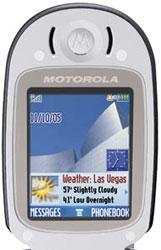
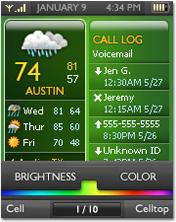
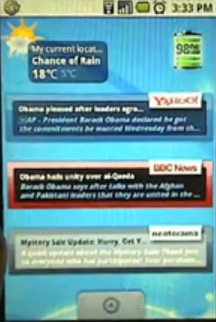
Pictured above left to right are: Motorola's Java-based Screen3 – the first idle screen solution, Alltel's BREW-based Celltop, not exactly an idle-mode application, but launched from the idle screen (Designed by Frog Design), and the new Android 1.5 widgets.
Who will own the home or idle screen and the widgets on it? Who will have the final decision of which application(s) will run as the home/idle-mode application? Would it be the network operator? Hopefully not; we don't want to see a new kind of walled-garden, this time with respect to the home/idle screen. Would it be the handset manufacturer? Probably not; they will do what their customer, the network operator, ask. Would it be the end-user? Hopefully the answer is yes; it is the user, the one who is able to search for, choose, download and install their favorite home/idle-mode application anytime they want. The user, the decider. ;-)
MIDP3 is defining an API that will allow developers to write idle-mode Java-based graphical applications that become visible when the handset enters the idle mode; this ScreenSaver MIDlet might not be truly interactive though. BREW already has such API, the uiOne.
Combine home/idle-mode applications with Widgets, and we've got an ideal “platform” to deliver relevant, on-time information to the user… I truly believe so – see Screen3 and Celltop above (I like very much the Celltop design).
Idle Screen + Mobile Widgets = ideal “platform” to deliver relevant information anytime
To developers… be (mentally and financially) prepared to sign and pay for the privilege to deploy your idle-mode applications… Access to the idle screen will be considered a premium, and a privilege operation.
Let me reiterate – I really hope the user gets the final word, and the freedom to choose between idle-mode applications, and that we don't see unnecessary control, and a new type of walled-garden…
ceo
Updates:
* Mar-30-07: Incorporated Ander's feedback.
* May-5-09: Refresh updates; included Android widgets
Pingback: About Mobility » Blog Archive » Android Widgets coming soon and they look fantastic
Pingback: Android Widgets coming soon and they look fantastic « Austin Entrepreneur Network